

It’s rare to see two national teams play each other twice in just three days, but that’s exactly what happened this week in South Africa. Harambee Stars bounced back from a gritty 1-1 draw against Likuena with a commanding 4-0 victory in a unique international friendly double-header. The matches took place at the Lucas Masterpieces Moripe Stadium in Pretoria, serving as a crucial preparation block for both sides ahead of upcoming competitive fixtures.
The first encounter on Thursday, June 4, was a nail-biter that ended in a stalemate. But wait—three days later, the script flipped entirely. Kenya dominated the return fixture on Monday, June 7, showcasing tactical adjustments and raw firepower that left their Basotho counterparts chasing shadows.
A Tight First Encounter
The opening match on June 4 kicked off at an unusual 9:00 AM local time—a logistical choice likely made for broadcast convenience rather than fan comfort. With only about 50 spectators in attendance, the atmosphere was quiet, but the intensity on the pitch was high. Referee Jelly Chavane oversaw a tense affair where chances were scarce until they mattered most.
Frank Odhiambo gave Kenya the early advantage, finding the net in the 12th minute. For nearly an hour, the Harambee Stars held firm, managing the game with defensive discipline. But football is a game of moments, and Lesotho found theirs late. In the 70th minute, Thabo Makhele equalized for Likuena, forcing a 1-1 draw that would stand until the final whistle blew at 90'+5'. It was a hard-fought result that showed Lesotho’s resilience, even if it wasn’t enough to secure a win.
Kenya’s Dominant Response
If the first match was a test of endurance, the second was a display of efficiency. On June 7, Kenya came out firing. They didn’t just want to win; they wanted to prove they could control the tempo against a team that had shown fight just days prior.
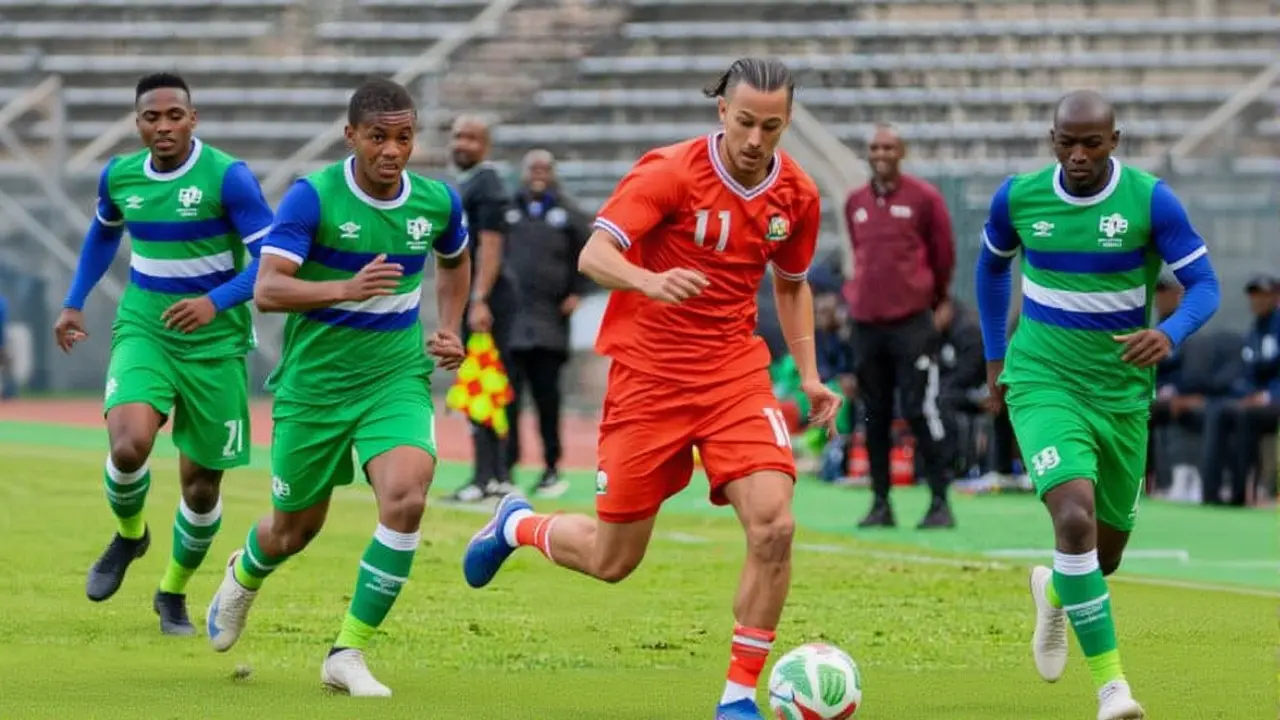
The goals started flowing early. Mohammed Bajaber opened the scoring in the 8th minute, setting the tone for a one-sided afternoon. He doubled his tally—and Kenya’s lead—in the 52nd minute, ensuring the halftime score reflected the day’s dominance. By then, Lesotho’s defense looked rattled, unable to contain the Harambee Stars’ attacking movement.
The second half became a formality. Lawrence Ouma stepped up in the closing stages, adding two more goals in the 84th and 88th minutes. His brace sealed a comprehensive 4-0 victory, giving Kenya a clean sheet and a significant morale boost. Meanwhile, players like Sekhoane Moerane for Lesotho struggled to make an impact, highlighting the gap in quality when Kenya played at full speed.
Why This Double-Header Matters
You might wonder why teams agree to such a short turnaround. Typically, international breaks allow for longer recovery periods between matches. This experimental format, however, offers valuable data for coaches. It tests squad depth, physical conditioning, and tactical adaptability under pressure.
For the Football Kenya Federation, based in Nairobi, this series provided insight into how their players handle rapid transitions. The shift from a tight defensive battle to an open, attacking game in just 72 hours is a real-world simulation of tournament conditions. Similarly, the Lesotho Football Association gained experience in managing expectations and performance consistency away from home.
The betting markets also took note. The over/under line for the first match was set at 1.5 goals. With exactly two goals scored, those who bet the over walked away winners—a small detail that underscores how closely contested the initial game was. Experts suggest that while friendlies don’t count toward rankings, the psychological edge gained from a dominant performance can carry over into qualifiers.
Looking Ahead
Both teams will now turn their attention to future competitive fixtures. Kenya’s ability to bounce back strongly suggests their coaching staff has identified key areas for improvement. The partnership between Bajaber and Ouma looks particularly promising, offering a dynamic threat in the final third.
For Lesotho, the focus will be on defensive organization. Conceding four goals in a friendly is a wake-up call, but the fact that they drew the first match shows potential. If they can replicate that resilience while tightening up at the back, they remain dangerous opponents in regional competitions.
Frequently Asked Questions
Where were the Kenya vs Lesotho friendlies played?
Both matches were held at the Lucas Masterpieces Moripe Stadium in Pretoria, South Africa. This neutral venue was chosen to facilitate travel logistics and provide a controlled environment for both teams during their preparation period.
Who scored the goals in the 4-0 victory?
Mohammed Bajaber scored twice (in the 8th and 52nd minutes), and Lawrence Ouma added two late goals (in the 84th and 88th minutes) for Kenya. No goals were scored by Lesotho in this match.
Why did the teams play two matches in three days?
This double-header format is an experimental approach to international scheduling. It allows coaches to assess player fitness, tactical flexibility, and squad depth under compressed timelines, simulating the intense schedule of major tournaments like the AFCON qualifiers.
What was the attendance for these matches?
Attendance was extremely low, with only about 50 spectators recorded for the first match on June 4. This suggests the games were played behind closed doors or with restricted access, likely due to security protocols or stadium availability constraints.
How does this affect FIFA rankings?
These matches are classified as International Friendlies and do not directly impact FIFA World Rankings. However, strong performances can influence coach selection strategies and player confidence leading into official qualifying campaigns.
Sohni Bhatt
It is truly disheartening to witness the decline of African football when such basic logistical failures occur, yet here we are discussing a double-header as if it were some grand tactical innovation rather than a symptom of systemic neglect. The notion that playing two matches in three days serves any purpose other than exploiting player labor for broadcast convenience is laughable, especially when one considers the physical toll on athletes who are already overworked by domestic leagues and international duties alike. I find it pretentious to assume that this 'experimental format' yields valuable data when the sample size is so small and the conditions so artificial, with barely fifty spectators present to provide any semblance of atmosphere or pressure. One must question the integrity of federations that prioritize scheduling convenience over athlete welfare, suggesting a deeper cultural issue within these organizations that values optics over substance. It is not merely about the scoreline but about the respect shown to the players who are treated as disposable assets in a game that should be revered for its artistry and athleticism.
The lack of crowd presence further diminishes the significance of these encounters, reducing them to mere training exercises disguised as competitive fixtures, which does little to enhance the reputation of either national team on the global stage. We see this pattern repeatedly across developing football nations where resources are misallocated towards superficial projects rather than grassroots development or proper medical support systems for professionals. This approach reflects a broader elitist attitude among administrators who believe they can bypass traditional methods of preparation without consequence, ignoring decades of sports science research on recovery periods. Such arrogance leads to injuries and burnout, ultimately harming the very talent pool these federations claim to nurture for future success in continental competitions.
Prashant Sharma
One might argue that the conventional wisdom regarding rest periods between matches is itself a construct designed to protect established interests rather than optimize performance outcomes in modern football contexts. While most observers criticize the compressed schedule, there is merit in testing squad depth under duress, provided the players are adequately compensated and monitored for physiological stress markers. The idea that friendlies hold no value because they do not affect rankings is a superficial take that ignores the psychological momentum gained from dominant performances against regional rivals. Kenya’s ability to shift gears from a defensive stalemate to an offensive showcase demonstrates adaptability, a trait often overlooked in favor of static tactical analysis. Therefore, dismissing this experiment outright fails to engage with the nuanced reality of contemporary football management where flexibility is increasingly prized over rigidity.
Gaurav Jangid
Oh my god!! Can you believe Bajaber just absolutely destroyed them??!! 😱😱😱 It was like watching a predator hunt! Lawrence Ouma too!! Two goals at the end!! What a finish!! 🎉🎉🎉 The defense looked so shaky for Lesotho, poor things! But hey, that's football baby!! ❤️❤️❤️ So much energy!!
Ghanshyam Gohel
Indeed, the performance was quite remarkable; however, we must acknowledge the structural vulnerabilities exposed by Lesotho's defensive line, which suggests a need for immediate strategic intervention. The rapid transition from a draw to a comprehensive defeat highlights the importance of mental resilience in high-pressure environments, a factor that cannot be overstated in professional sports psychology. Furthermore, the lack of spectator engagement raises questions about marketing strategies employed by local authorities, which may require reevaluation to foster greater community involvement. It is imperative that stakeholders consider these multifaceted challenges holistically rather than focusing solely on the final scoreline, as sustainable growth depends on addressing underlying systemic issues effectively.
Nathan Lemon
From a cultural perspective, these matches serve as a bridge between nations, fostering understanding through the universal language of sport, even if the execution leaves much to be desired. The neutral venue in Pretoria allowed both teams to experience a shared environment, promoting camaraderie despite the competitive nature of the events. Such initiatives, though flawed in their scheduling, contribute to the broader narrative of African unity and cooperation on the continent. It is essential to view these efforts as steps toward greater integration, recognizing the symbolic value they hold beyond mere athletic achievement. The diplomatic implications of such gatherings should not be underestimated in our interconnected world.
Abhijit Pawar
Bajaber is lethal. Ouma sealed it. Simple as that.
lavanya tolati
i think lesotho needs to work on their defense but they fought hard in the first game so kudos to them for trying
srinivasan sridharan
How utterly fascinating how everyone celebrates this 'victory' while ignoring the blatant exploitation of players' bodies for the sake of arbitrary metrics. Truly, the human capacity for self-deception knows no bounds when money is involved. One wonders if the coaches feel any remorse for pushing athletes to the brink of injury for a friendly match that means nothing in the grand scheme of FIFA rankings. Perhaps next time they will play three games in two days to see if anyone survives. Progress!
Anant Kamat
pretty cool to see kenya bounce back like that. the first game was tight but the second one showed real strength. hope they keep this form for qualifiers
Raja Meena
It is morally questionable to subject athletes to such rigorous schedules without adequate consent or compensation, reflecting a disregard for individual rights in pursuit of collective glory. The ethical implications of prioritizing organizational goals over personal well-being cannot be ignored, as it sets a dangerous precedent for future sporting events. Players deserve protection from exploitative practices that undermine their health and career longevity, regardless of the potential benefits to their national teams. Society must demand accountability from those in power who make such decisions behind closed doors.
Pooja Kiran
Let's cut the crap: this was a mismatch from minute one in the second game. The tactical setup by Kenya was superior, exploiting every gap in Lesotho's backline. Bajaber's movement off the ball created space for Ouma to capitalize late on. No wonder the betting markets shifted so dramatically. Amateur hour for Likuena.
Gaurav sharma
You're all missing the bigger picture here! This isn't just about football; it's about dominance! Kenya showed exactly why they are the kings of the region! Lesotho had no chance once the tempo increased! Look at the stats! Possession! Shots on target! Everything screams superiority! Stop making excuses for the losers!
Megha Khairnar
Perhaps we should reflect on the philosophical underpinnings of competition itself. Is victory the sole measure of success, or does the journey of improvement hold equal weight? Kenya demonstrated excellence, but Lesotho displayed resilience in the initial encounter. Both qualities are vital for holistic development in sports. We must embrace diversity in outcomes and recognize the value of effort regardless of the final result. Unity in sports transcends winning and losing.
Twinkle Vijaywargiya
What a great opportunity for both teams to learn from each other!! The exchange of ideas and tactics is invaluable for growth!! Let's celebrate the spirit of friendship that binds us together through sport!! Together we rise!! 🌍⚽
Swetha Sivakumar
it was nice to see the players enjoying themselves despite the low attendance. the focus seems to be on preparation rather than spectacle right now
diksha gupta
Wow what a turnaround! From a draw to a thrashing! Kenya really stepped up their game! Love seeing homegrown talent shine on the big stage! Keep going stars! ✨
Sai Krishna Manduva
Is it possible that the concept of 'rest' is merely a societal construct designed to limit human potential? By challenging this norm, Kenya has proven that adaptability trumps tradition. The results speak for themselves, rendering conventional wisdom obsolete. We must question everything we thought we knew about sports science.
Siddharth SRS
The emotional burden placed upon the players during such an intense period cannot be understated, as they navigate the complexities of expectation and performance anxiety in a vacuum devoid of external support structures. One observes a profound sense of isolation amidst the chaos, highlighting the need for robust psychological frameworks within national teams. The silence of the stadium mirrors the internal struggles faced by individuals striving for excellence under duress. It is a poignant reminder of the human cost associated with competitive ambition.
Subramanian Raman
I am curious to know how the coaching staff managed the rotation of players between the two matches to prevent fatigue. Did they rely heavily on substitutes or did key starters play full minutes in both games? Understanding the squad management strategy would provide insight into their long-term planning for upcoming tournaments. 🤔
Shreyanshu Singh
this whole thing feels fake.. who plays twice in 3 days for fun?? probably just showing off for sponsors.. typical corrupt system.. dont buy into the hype..