
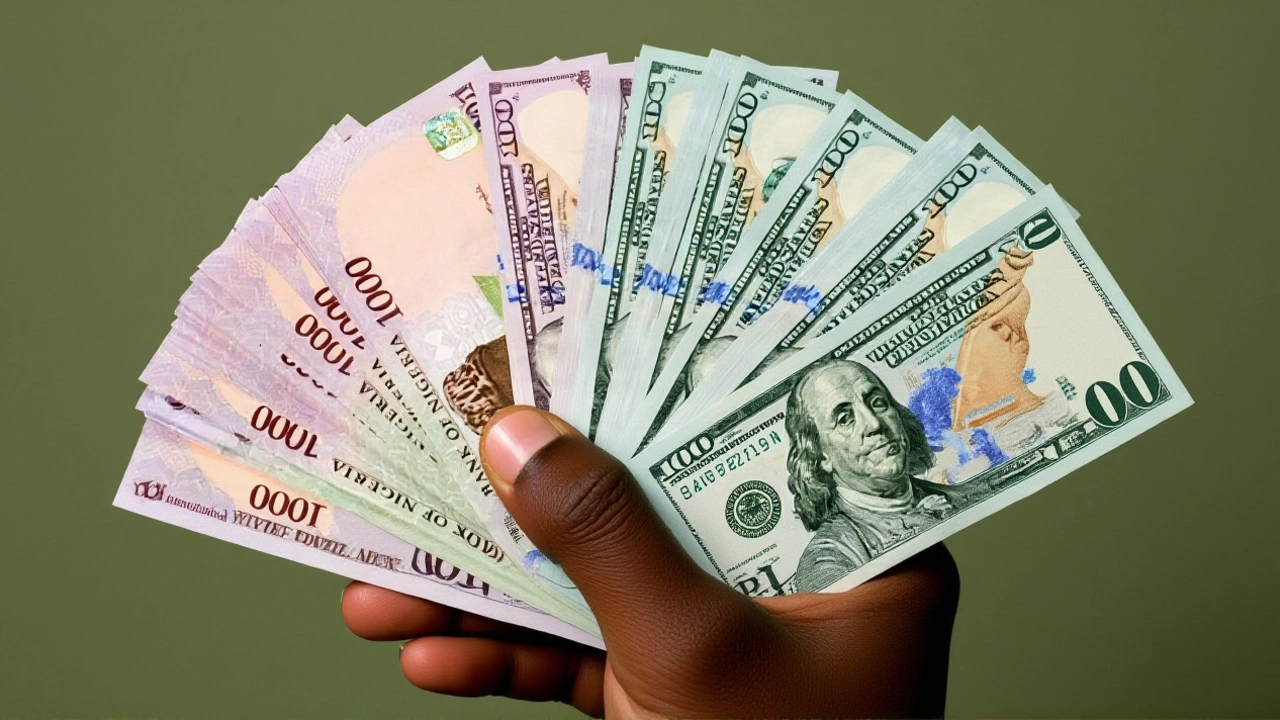
By early September 2025, the Nigerian Naira had clawed back to its strongest position in over a year, hitting 1,526.54 NGN per USD on September 2 — a sharp reversal from the chaos of late 2024, when the currency plunged to 1,717.50 against the dollar. The move wasn’t a flash in the pan. Over the next four weeks, the Naira kept climbing, ending the month at 1,480.21 NGN per USD, a 3.3% monthly gain. For Nigerians who’ve watched their savings evaporate in parallel markets, this wasn’t just data — it was relief.
A Quiet Revolution in Forex Policy
The Central Bank of Nigeria didn’t announce a dramatic policy shift. No sudden devaluation. No emergency intervention. Instead, it let its Nigerian Foreign Exchange Market (NFEM) operate with more transparency, allowing dollar supply to respond to real demand rather than artificial controls. Traders noticed. Importers who’d been stuck waiting months for forex began getting allocations. Oil companies, the backbone of Nigeria’s dollar earnings, reported smoother repatriation of revenue. By September 30, the average NFEM rate stood at 1,500.60 NGN per USD — a far cry from the 1,600+ rates seen just six months prior.What’s Driving the Surge?
It’s not just one thing. It’s a chain reaction. First, crude prices stabilized above $75 a barrel, lifting Nigeria’s export receipts. Second, foreign investors, spooked by inflation in Europe and the U.S., started looking at emerging markets again — and Nigeria, with its 27% interest rate, looked tempting. Third, the CBN quietly cracked down on illegal forex brokers, shutting down over 300 unlicensed bureaux de change in Lagos and Abuja between July and August. That reduced the black market’s grip. "We’re seeing real demand meeting real supply," said a Lagos-based currency trader who asked not to be named. "Before, you’d pay 1,800 Naira for a dollar because the system was broken. Now, the gap between official and parallel rates is down to 5% — the narrowest in two years."The Parallel Market’s New Reality
The Nigerian parallel market, once the heartbeat of the currency’s fate, is now a shadow of its former self. On September 30, 2025, Vanguard Nigeria reported traders expected the Naira to trade between 1,495 and 1,505 in the unofficial market — just slightly weaker than the official rate. By late October, the gap had shrunk further. On October 17, the Naira dipped to 1,475.35 in the parallel market — its weakest point that month — but bounced back within days. By November, the parallel rate hovered around 1,460, compared to the CBN’s official rate of 1,441.Global Context: Rates, Inflation, and Investor Confidence
The U.S. Federal Reserve held its benchmark rate steady at 4.00–4.25% through October 2025, while Nigeria’s 27% rate remained one of the highest in the world. That gap — nearly 23 percentage points — made Nigerian bonds irresistible to carry traders. Foreign portfolio inflows into Nigerian government securities jumped 38% in Q3 2025, according to data from the Nigerian Securities and Exchange Commission. Investors weren’t just chasing yield; they were betting on stability. Meanwhile, inflation, which had hovered near 30% in early 2025, fell to 22.1% by November — the lowest in 18 months. That’s not yet comfortable, but it’s moving in the right direction. "The Naira’s strength isn’t magic," said Dr. Adebayo Ogunleye, an economist at the University of Lagos. "It’s the result of patience, consistency, and a willingness to let the market breathe."What’s Next? The Projections
Trading Economics forecasts the Naira will end 2025 at 1,448.20 per USD — a 2.4% gain from November levels — and reach 1,413.93 by November 2026. That would mean a 20% appreciation from the 2024 peak. Even the most optimistic analysts didn’t see this coming a year ago. But now, the trend is clear: Nigeria’s forex reforms are working. The CBN’s latest monthly report noted a 14.33% year-over-year appreciation of the Naira as of November 27, 2025 — the strongest annual gain since 2019. The currency’s value, measured against a basket of global currencies, rose 9.2% in 2025 alone. "This isn’t a bounce," said one international fund manager based in Johannesburg. "It’s a re-rating. Investors are starting to see Nigeria as a country that can manage its own economy."Still Not Out of the Woods
Don’t mistake stability for security. The Naira’s gains are fragile. A sudden drop in oil prices, a surge in imports, or political instability could unravel progress. The parallel market still exists. Many households still rely on it. And while the CBN has improved transparency, it hasn’t yet fully liberalized the forex system. There’s still a long way to go before the Naira becomes truly convertible. But for now, Nigerians are breathing easier. Parents can buy school supplies without losing half their savings to black market spreads. Small businesses can import raw materials without waiting months. And for the first time in years, people are talking about saving in Naira again — not just in dollars.Frequently Asked Questions
Why did the Naira strengthen in September 2025 after years of decline?
The Naira’s strength in September 2025 stemmed from improved foreign exchange supply, reduced illegal forex trading, and higher oil revenues. The Central Bank of Nigeria allowed its official market to reflect real demand, which narrowed the gap between official and parallel rates. Combined with rising investor interest due to Nigeria’s high interest rates, this created sustained upward pressure on the currency.
How does the 27% interest rate affect the Naira’s value?
The Central Bank of Nigeria’s 27% interest rate makes Nigerian bonds highly attractive to foreign investors seeking yield, especially when compared to the U.S. Federal Reserve’s 4–4.25% rate. This inflow of foreign capital increases demand for Naira, pushing its value up. However, this also risks overheating the economy if not paired with fiscal discipline and inflation control.
What’s the difference between the official and parallel market rates?
The official rate, set by the Central Bank of Nigeria’s NFEM, reflects wholesale forex transactions between banks and approved institutions. The parallel market is where individuals and small businesses trade cash dollars. In September 2025, the gap narrowed to under 5%, down from over 40% in 2024. This convergence signals improved market confidence and reduced scarcity.
Will the Naira keep strengthening into 2026?
Analysts at Trading Economics project the Naira will reach 1,413.93 per USD by November 2026, a further 2.4% gain from November 2025 levels. This assumes steady oil prices, continued CBN policy discipline, and no major political shocks. If Nigeria can reduce inflation below 20% and boost non-oil exports, the Naira could stabilize even further.
What role did the crackdown on illegal forex dealers play?
Between July and August 2025, over 300 unlicensed forex bureaux were shut down in Lagos and Abuja, reducing the supply of illicit dollars and weakening the parallel market’s influence. This helped restore trust in the official system. Traders no longer feared sudden rate spikes caused by black market manipulation, making the official rate more reliable for businesses and consumers.
How does this compare to Nigeria’s currency history?
The Naira’s 14.33% annual gain in 2025 is the strongest since 2019, when it appreciated 12% after the CBN unified its exchange rate tiers. The 2024 peak of 1,717.50 NGN per USD was the worst in decades. The 2025 recovery marks the first sustained, policy-driven appreciation since 2016, suggesting structural improvements rather than temporary fixes.
Omkar Salunkhe
lol 1480? i saw 1650 on my local guy's whatsapp group yesterday. they just moved the goalposts. cbn is lying through its teeth. this 'stability' is just window dressing. wait till the next oil dip.
raja kumar
This is actually a quiet win for Nigeria. Not flashy, not dramatic, but consistent policy over time. Many countries would have panicked and reversed course. The narrowing gap between official and parallel rates is the real indicator of trust returning. Small steps, but meaningful.
Sumit Prakash Gupta
The macro fundamentals are aligning: high yield differential + reduced forex arbitrage + improved capital inflows = structural appreciation. This isn't a bounce, it's a regime shift. The carry trade is back in play, and the CBN's non-interventionist stance is the catalyst. Game changer.
Shikhar Narwal
finally some good news from naija 🙌👏 i’ve been waiting for this for years. parents can buy school stuff again? yes please. small biz owners can import without waiting 6 months? yes yes yes. this is what real progress looks like 💪
Ravish Sharma
Oh wow, the CBN actually did something right? Shocking. Next they’ll admit the Naira was never supposed to be pegged to the dollar in the first place. Maybe next year they’ll stop printing money like it’s confetti. But hey, at least the parallel market is now a polite suggestion instead of a dictatorship.
jay mehta
YESSSSSSSSSSS!!!! This is what happens when you stop being afraid of the market!!! 27% interest rates are NOT a bug, they’re a FEATURE!!! Investors are FINALLY seeing Nigeria as a real economy, not a broken vending machine!!! LET’S GOOOOOOOOOOOO!!!
Amit Rana
The key here is predictability. For years, forex access was a lottery. Now, if you’re a legitimate importer or exporter, you know where you stand. That’s the real win. Stability isn’t about the number on the screen - it’s about knowing the rules won’t change tomorrow.
Rajendra Gomtiwal
India did this in 1991. Nigeria is just late to the party. Why are we even celebrating? This is basic economics. Stop acting like this is a miracle. The CBN just did what any central bank should have done a decade ago.
Yogesh Popere
You think this is good? Wait till the next election. They’ll start printing again. This is all smoke and mirrors. The real problem is corruption. You can’t fix a broken system with spreadsheets.
Manoj Rao
The entire narrative is a construct. The CBN didn’t 'let the market breathe' - they orchestrated this through covert capital controls disguised as liberalization. The 27% rate? A trap. It’s a Ponzi scheme disguised as monetary policy. The parallel market is still the true barometer - and it’s not fooled.
Alok Kumar Sharma
Nigeria’s currency is still garbage. This is temporary. Wait for the next oil crash.
Tanya Bhargav
i’m so happy for the mums and small shop owners who’ve suffered so long. i remember lining up for dollars in 2023. it felt like begging. now maybe they can just buy what they need without crying. that’s the real win, not the numbers
Sanket Sonar
The 5% gap between official and parallel is telling. That’s the first time since 2018 it’s been under 10%. Means the arbitrage window is closing. That’s structural. Not luck.
pravin s
I wonder if this will encourage more local manufacturing? If import costs drop, maybe people will start buying local again. That’d be the real game-changer.
Bharat Mewada
There’s a deeper truth here: when a society stops fearing its own currency, it starts believing in its future. The Naira’s rise isn’t just about forex - it’s about collective psychological shift. People are saving again. That’s more powerful than any interest rate.
Ambika Dhal
This is just another elite victory. The poor still can’t access the official rate. The CBN’s 'transparency' is a myth. The parallel market is still where real people live. This is performative economics.
Vaneet Goyal
I’m skeptical. The CBN still controls the bulk of forex allocation. This isn’t free market - it’s managed liberalization. And 27% interest rates are unsustainable. This is a bubble waiting to burst. Don’t be fooled by the headline numbers.
Amita Sinha
they're all lying. the real reason? the cbn sold off all the gold reserves and used it to buy dollars behind the scenes. this isn't reform - it's a shell game. and now they're pretending it's magic. 🤡